One aspect of autism that I had no idea about was sensory and stimulation issues. I had always wondered why children with autism have such crazy tantrums, or can completely tune out their environment. After reading a few books and some internet research, I learned the real reason. It seems so crazy because my son is affected by it and I had no idea. We just thought he couldn't hear, which was the case for a few months. I have learned so much about the sensory complications that plague those with autism.
My son had chronic ear infections from the time he was 12 months to 20 months. At one point, he was at a 10% hearing capacity due to dried fluid in his ears from the ear infections. The fluid wasn't draining after the infection was cleared, just drying up and building up. When the Ear, Throat, and Nose doctor told us he couldn't hear well at all, we thought that was the issue. We really thought that he would get tubes placed in his ears, be able to hear, and then start to become a talking machine. We were wrong.
He did show more awareness of our presence, and did look at us more when we would call his name, but the talking still didn't come. He even lost some of the language he had before. And if someone other than his parents were talking to him, he would seemingly ignore them. He also never had any reaction to most loud noises. Thunder, vacuum, screaming, loud laughing, dogs barking, etc. He could sleep through these things, as well as not even flinch when awake in their presence.
We would take my son out to dinner or shopping and he would sit calmly in the car/high chair, playing with something incredibly simple (a receipt, a straw wrapper, etc.) and ignore the environment. He also drooled excessively with no obvious cause. He had all of his teeth, so he was no longer drooling because of that. He would soak shirts from the amounts of drool. Laundry was not my favorite thing to do at this time.
When we were given the initial diagnosis, we researched. That research then gave us answers to all of our questions about his aloofness and drooling. Our son was hypo-sensitive, meaning that he was severely under stimulated. Sensory processing is an issue for almost all children with autism. The tantrums and meltdowns that can come with those children generally stem from one of two issues: communication and sensory stimulation. My son rarely had meltdowns or tantrums, and even those were minor. I know that there are many parents who deal with full fledged tantrums and meltdowns, where their child looses all control. I was at least lucky in this part.
Being hypo-sensitive, my son is under stimulated by his environment. He doesn't feel things or sense things the way most people do. Most people can distinguish between the sound of a car driving by and the sound of a person talking, my son does not. The only sounds my son seems to distinguish almost all the time is music. Like most autistic children, he is drawn to music. It calms him and brings him joy.
He also has a very high pain tolerance. How many parents can say that their kid will fall, scrape his knee, be bleeding, and not even flinch? Not many. My son rarely cries or notices pain. I have noticed that he has to hit his head in some way to be affected by pain. He sometimes rubs his arm on this wooden fence at our apartment complex just to feel it, giving him splinters. He had a nasty abrasion on his arm for a week and he still tries to do it. I have to watch him carefully to avoid things like this from happening.
My son is also constantly on the move, running back and forth in our apartment, jumping, bouncing on the couch, banging toys on the table/wall/floor, etc. He never seems to chill out. The psychologist that evaluated him stated that he is in a constant state of seeking visual and auditory stimulation.
The drooling is also directly linked to his under stimulation. We took him to a children's farmstead one morning and noticed he hadn't drooled the entire time we were there. That's when we knew that his sensory stimulation was directly related. We told our OT (occupational therapist) about this discovery and she began to give us ideas for things to do. She suggested try foods with bolder flavors, extremely cold beverages, and using straws. We took it a step further and make sensory play items, such as bags, bins, and bottles. On my other blog, I describe how I made them. Check the sensory toys out here.
We play with him with the sensory toys and he loves them! He even comes running when he hears the sound of the items. He will actually sit still and play nicely with the sensory bins in particular. It's just dried beans, some measuring cups, and some rubber action figures. It's so simple, but he absolutely loves it. If we use sensory toys with him a few times a day, roughly 10 minutes at a time, he stops drooling. He seems to be more conscious of the fact that he needs to swallow.
Life, and laundry, has gotten easier for us just by doing a few simple things to help my son with his hypo-sensitivity.
Friday, June 15, 2012

Wednesday, June 13, 2012
Diagnosis
Wow. That is one word to describe my feelings. And not the sense of 'wow that's awesome,' but the sense of 'wow, what do i do now?'. I don't think it is possible to count the number of emotions that go through your mind when you hear that you child has autism.
I had a very vague understanding of autism when the evaluation was taking place. I originally thought that I knew what it was. Strange mannerisms, delayed speech, OCD-like behaviors, socially awkward. It was a temporary setback in his development. I was so very wrong.
After the psychologist's initial evaluation of him, she said that she felt comfortable telling us that she planned on giving him and autistic disorder diagnosis. This was the official diagnosis unless questionnaires from daycare and speech therapy told her otherwise. What she saw was what they saw, so this was it.
The first question we asked was "Is he going to be okay?" That is what every parent wants to know. She said yes, with lots of work and therapy. So this wasn't a temporary setback. It could be permanent if we didn't do our best.
As she began to explain how our son's mind worked, I couldn't help but feel like my son was this alien in the room with us human beings. I know, it's completely horrible, but this is all too common apparently. Every book I have read since then states that most parents feel as though they don't know who the kid is anymore. Even Jenny McCarthy reported feeling this way when the doctor diagnosed her child.
After reading more information on the AutismSpeaks.org website later that afternoon, I began to understand more about my son. While reading and feeling like he was still an alien, he came up to me at the computer and tried to climb into my lap. I picked him up and cuddled with him. It almost seemed as though he knew something was bugging me. Daddy and I had cried and he wanted to comfort me. It was this simple action from him that made me snap out of my feelings that I did not know this child. I did know him! I knew what he liked to do, to eat, to play with, when he wants to cuddle, and what his actions mean. What had changed was me, not him. He had always thought in this specific way; I was the one with the wrong impression of him.
It took about a solid week before I was able to talk directly about it without getting teary-eyed. It was really hard to accept, but after the reading I had done on the topic, I knew that I needed to move past the initial grief and get to acceptance.
Many books and articles I have read about life right after the diagnosis compare your feelings to that of the 5 stages of grief: bargaining, denial, depression, anger, and acceptance. Most parents feel these stages, but not in any particular order or even all of them. I felt them all, and even went back and forth with them from time to time. I made myself work through the emotional aspects of the stages so I could get to acceptance. That was the important part, accepting reality and moving forward.
The reason for feeling these 5 stages is because you lose the idea you had of your child's future. It is a profound sense of loss, just like a death. I had dreamed that my son would grow up to play college basketball at KU, but now I know that may not happen. Sure my kid is really tall for his age now, and even takes an interest in playing with his basketball goal, but he may develop other talents or interests. That could have happened anyways, but him having autism prevents me from seeing his future in any way. I don't know how far therapy will take him. Right now, he barely says anything and is just now beginning to develop receptive language at the age of 30 months. He also has little desire to play with other children or interact with most adults.
My suggestion to anyone else with a newly diagnosed child? READ! You will learn so much about how to help your child and also about how your child functions. My kid would go through periods of time at daycare and not eat. After studying when those events occurred, I came to realize that it was after his schedule had changed. He also would not sleep, which was after his schedule changed. He could barely communicate hunger to me, let alone tell me how anxious schedule and environment changes made him.
Learning how your child sees the world and his interactions within them will be of great help. I have a few books that I have read, which I definitely recommend.
 The Everything Parent's Guide To Children With Autism
This book was so informative and helpful! It gives you information on how to cope, what to expect with your friends and family, how to apply for aid, resources for further information, and even little know problems that may arise. Definitely good for someone who knows very little about Autism.
 Louder Than Words
This book is somewhat controversial, but I like how you get insight into what living with a child with autism is like. You also get to see how another mother reacts to this and that your own feelings are normal. She discusses many different types of treatments, some that I don't even agree with. But either way, I felt this book initially helped me.
I had a very vague understanding of autism when the evaluation was taking place. I originally thought that I knew what it was. Strange mannerisms, delayed speech, OCD-like behaviors, socially awkward. It was a temporary setback in his development. I was so very wrong.
After the psychologist's initial evaluation of him, she said that she felt comfortable telling us that she planned on giving him and autistic disorder diagnosis. This was the official diagnosis unless questionnaires from daycare and speech therapy told her otherwise. What she saw was what they saw, so this was it.
The first question we asked was "Is he going to be okay?" That is what every parent wants to know. She said yes, with lots of work and therapy. So this wasn't a temporary setback. It could be permanent if we didn't do our best.
As she began to explain how our son's mind worked, I couldn't help but feel like my son was this alien in the room with us human beings. I know, it's completely horrible, but this is all too common apparently. Every book I have read since then states that most parents feel as though they don't know who the kid is anymore. Even Jenny McCarthy reported feeling this way when the doctor diagnosed her child.
After reading more information on the AutismSpeaks.org website later that afternoon, I began to understand more about my son. While reading and feeling like he was still an alien, he came up to me at the computer and tried to climb into my lap. I picked him up and cuddled with him. It almost seemed as though he knew something was bugging me. Daddy and I had cried and he wanted to comfort me. It was this simple action from him that made me snap out of my feelings that I did not know this child. I did know him! I knew what he liked to do, to eat, to play with, when he wants to cuddle, and what his actions mean. What had changed was me, not him. He had always thought in this specific way; I was the one with the wrong impression of him.
It took about a solid week before I was able to talk directly about it without getting teary-eyed. It was really hard to accept, but after the reading I had done on the topic, I knew that I needed to move past the initial grief and get to acceptance.
Many books and articles I have read about life right after the diagnosis compare your feelings to that of the 5 stages of grief: bargaining, denial, depression, anger, and acceptance. Most parents feel these stages, but not in any particular order or even all of them. I felt them all, and even went back and forth with them from time to time. I made myself work through the emotional aspects of the stages so I could get to acceptance. That was the important part, accepting reality and moving forward.
The reason for feeling these 5 stages is because you lose the idea you had of your child's future. It is a profound sense of loss, just like a death. I had dreamed that my son would grow up to play college basketball at KU, but now I know that may not happen. Sure my kid is really tall for his age now, and even takes an interest in playing with his basketball goal, but he may develop other talents or interests. That could have happened anyways, but him having autism prevents me from seeing his future in any way. I don't know how far therapy will take him. Right now, he barely says anything and is just now beginning to develop receptive language at the age of 30 months. He also has little desire to play with other children or interact with most adults.
My suggestion to anyone else with a newly diagnosed child? READ! You will learn so much about how to help your child and also about how your child functions. My kid would go through periods of time at daycare and not eat. After studying when those events occurred, I came to realize that it was after his schedule had changed. He also would not sleep, which was after his schedule changed. He could barely communicate hunger to me, let alone tell me how anxious schedule and environment changes made him.
Learning how your child sees the world and his interactions within them will be of great help. I have a few books that I have read, which I definitely recommend.
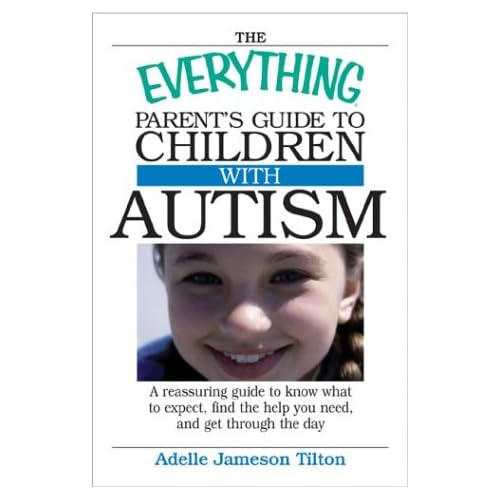 The Everything Parent's Guide To Children With Autism
This book was so informative and helpful! It gives you information on how to cope, what to expect with your friends and family, how to apply for aid, resources for further information, and even little know problems that may arise. Definitely good for someone who knows very little about Autism.

This book is somewhat controversial, but I like how you get insight into what living with a child with autism is like. You also get to see how another mother reacts to this and that your own feelings are normal. She discusses many different types of treatments, some that I don't even agree with. But either way, I felt this book initially helped me.
Subscribe to:
Posts (Atom)